
Lawn
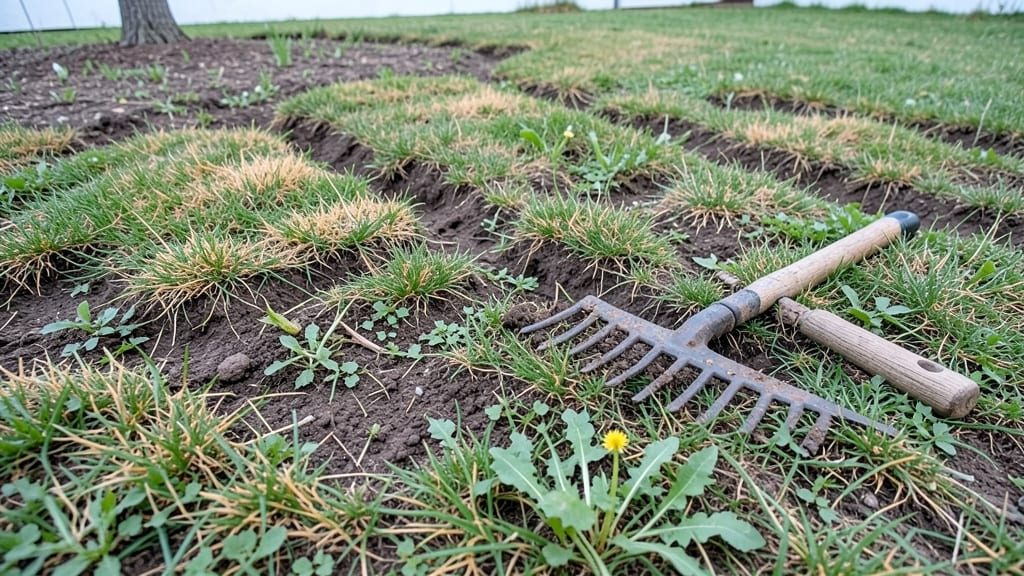
Tire ruts create dense soil layers that choke out grass roots by restricting water and air flow. 🌱 The problem worsens in heavy clay soils, where compaction becomes almost permanent without mechanical intervention.
I’ve seen ruts in sandy lawns recover faster—sometimes within a year—because the soil drains better, but even then, the grass often stays thinner in those areas.
The key difference is how quickly you act: spring and fall are the best times to address ruts because the soil is softer and recovery is more predictable.
If you’re dealing with ruts, the first step is aeration—it breaks up that compacted layer so roots can breathe again. After that, overseeding with a shade-tolerant grass mix helps fill in bare spots, while topdressing with compost or sand can level out the worst depressions.
For severe cases, sod patches work fastest but cost more upfront. The good news? With the right approach, you can restore your lawn’s health and evenness within a growing season.
💡 In This Article
- How Soil Compaction Prevents Grass Recovery in Tire Ruts
- Step-by-Step Rut Repair: Tools and Techniques for Fast Lawn Revival
How soil compaction prevents grass recovery in tire ruts
When vehicles drive repeatedly over the same lawn paths, they create tire ruts by compressing soil layers to 80-90% of their original volume.
This extreme pressure crushes soil particles together, reducing pore space by up to 50%—the very spaces that allow air, water, and roots to move freely. 🌱 The result?
Grass roots suffocate as oxygen levels drop below 10% of healthy soil, while water pools in the depressions instead of draining properly. This creates a vicious cycle: waterlogged conditions lead to fungal growth, while dry periods leave roots parched.
The damage varies dramatically by soil type. In clay-heavy soils, compaction becomes nearly permanent because the tiny particles bind tightly when wet, creating a dense, brick-like layer that resists natural breakdown.
Sandy soils, on the other hand, recover faster—sometimes within 12-18 months—because their larger particles allow better drainage and root penetration, though the grass often remains thinner in rutted areas.
Climate plays a role too: Northern lawns with cold winters may see slower recovery (2-3 years) due to frozen soil periods, while Southern climates with consistent warmth can show improvement in just 6-12 months.
The real problem isn't just the depression—it's what happens below ground. Compacted soil has 30-50% less microbial activity, meaning fewer beneficial bacteria and fungi that help break down organic matter and release nutrients. Without these helpers, grass struggles to establish new roots, even when you overseed.
The roots that do grow become shallow and weak, making the lawn more susceptible to drought, pests, and foot traffic damage. 💫 This is why ruts often turn into permanent "bare spots" that spread over time.
Here's what's actually happening at the microscopic level: Soil compaction increases the bulk density (weight per volume) of the top 2-4 inches of soil, where most grass roots live.
In healthy soil, bulk density sits around 1.2-1.4 g/cm³, but in ruts, it can exceed 1.6 g/cm³—like packing sand into a tight jar. This density restricts root growth to just 1-2 inches deep instead of the ideal 6-12 inches, leaving grass vulnerable to environmental stress.
One often-overlooked factor is how compaction affects water infiltration rates. In compacted soil, water may take 10-30 times longer to soak in compared to loose soil, leading to surface runoff that erodes the rut edges.
This creates a snowball effect: the more water runs off, the deeper the rut becomes, and the harder it is for grass to reclaim the area. The solution requires breaking this cycle by physically disrupting the compacted layer—something nature alone rarely accomplishes.
What most people don't realize is that even when grass eventually grows back in ruts, it often comes back thinner and less resilient. This happens because the compacted soil remains structurally weaker, making it easier for future traffic to create new ruts.
The only way to truly restore a lawn is to address the soil's physical properties—whether through aeration, organic matter addition, or mechanical soil loosening. Without intervention, those tire tracks become permanent features of your landscape. ✨